Huna Article
Huna International
Working With the Eye of Kanaloa
And Symbols Generally
by Graeme Kapono
Urlich
 Over the last 35+ years working with Huna, symbols, and in particular, the Eye of Kanaloa, the orientation
has always been with the single point of the star downwards. Abraham Kawaii used it that way. Ed Kaiwi
had a tattoo of the star that way. The star is depicted this way in Leinani Melville's book
“Children of the Rainbow.” I've only seen it depicted the other way up once, in error.
Over the last 35+ years working with Huna, symbols, and in particular, the Eye of Kanaloa, the orientation
has always been with the single point of the star downwards. Abraham Kawaii used it that way. Ed Kaiwi
had a tattoo of the star that way. The star is depicted this way in Leinani Melville's book
“Children of the Rainbow.” I've only seen it depicted the other way up once, in error.
More recently though, I am seeing it all over Instagram and other places depicted with the single point
upwards with meanings attributed to it that I have never heard of before. Sometimes I see it without any
regard to an orientation.
As with any symbol, we can add personal meanings for specific purposes. I do this and sometimes share these
with others as useful tools they may choose to use, but I always explain that this is something I made up
because it was useful. I make it clear it is not part of the source tradition, merely based on it, so the
core meaning is not lost.
Often the same or similar symbol may have different meanings in different traditions and it is important to
know which tradition and meaning is being used. Some people see a symbol and get a specific meaning from one
tradition and think this meaning applies to all traditions and variations of traditions. The meanings in
cultural contexts usually have many layers of meaning and Westerners in particular tend to only get
superficial understanding.
One group in Italy came up with a design they called an evolution of the Eye of Kanaloa. It had wavy lines
instead of straight lines and a Star of David in the centre with other images on it as well. There was
nothing remotely Hawaiian about it and I personally feel claiming it to be is disrespectful of the
tradition.
Other symbols have been distorted over the years. What is now known as the Nazi Swastika, with the
associated revulsion for what they did, originated in India 7000 years ago. Svastika is a Sanskrit word
meaning “well-being”, a symbol of good fortune and abundance for millennia in Hinduism, Buddhism, and
pre-Christian Europe before there were Nazis who used it as a symbol of racial superiority that is now
mostly associated with hatred and genocide.
Most people today are only familiar with the latter meaning and react to it accordingly. One Hindu man, not
so long ago, was attacked for displaying the symbol from his tradition because the attackers assumed the
latter meaning. Such are the consequences of a lack of knowledge and understanding. It is advisable to ask
someone what meaning they are using before taking drastic action based on misinformation.
In Hinduism it is used right-facing (swastika) symbolising surya (“sun”), prosperity and good luck, as well
and left-facing (sauvastika) symbolising night or tantric aspects of Kali. The depth of meaning of such
symbols simply can't be expressed in short articles such as this and require in depth study of the
traditions they come from to begin to comprehend them. Some Native American tribes, like the Navajo and
Hopi, have
used a similar symbol sometimes referred to as “whirling logs” to represent the four directions as well as
good luck and well-being. This is interestingly similar to the Asian Indian concepts. Was there a
connection? Hmmm.
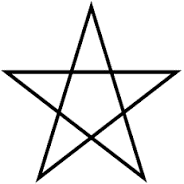 The pentangle is another symbol with mixed meanings in the modern age. Depicted with the single point
upwards it has positive connotations of magic and protection, among other things. In Mathematics it may be
associated with a “golden ratio.” When the single point is depicted downwards though, the symbol is usually
associated with things satanic and demonic. People unaware of the positive meanings may well interpret it as
having bad meanings regardless of the orientation and context, and potentially have a negative reaction to
it depending on the strength of the associations they have with it.
The pentangle is another symbol with mixed meanings in the modern age. Depicted with the single point
upwards it has positive connotations of magic and protection, among other things. In Mathematics it may be
associated with a “golden ratio.” When the single point is depicted downwards though, the symbol is usually
associated with things satanic and demonic. People unaware of the positive meanings may well interpret it as
having bad meanings regardless of the orientation and context, and potentially have a negative reaction to
it depending on the strength of the associations they have with it.
I personally do my best to teach Kupua Tradition as I have learned it, to keep a core foundation of the
tradition intact. I feel this is important so as not to dilute the effectiveness of the knowledge. I do this
by not allowing myself to change fundamental aspects of the knowledge or tinker too much with the various
symbols used. I must admit to feeling disquiet when I see others doing it but to some extent that can't be
helped.
I will typically only ever use and display the Eye of Kanaloa with the orientation I have always been taught
is the “correct”, traditional one, with the single point downwards. I will only ever teach it this way out
of respect for the tradition and my teachers. Yes there will be aspects of the Kupua Tradition that I have
yet to learn, layers I have yet to uncover, but until those come to my attention, I will stay with what I
have learned so far in order to perpetrate it in the purest form I am able. A Kahu is a caretaker of the
knowledge after all.
Graeme Kapono Urlich (March 2025)
The Eye Of Kanaloa (Information)
Aloha New Zealand - School of Huna and Hawaiian Shamanism
|

