Huna Article
Huna International
Creating Your Own Reality
by Graeme Kapono Urlich
Many schools of thought talk about creating our own reality. There is also the idea that everything we see
in the world is a reflection of our beliefs. Unfortunately many people take this idea too far and blame
themselves for all of the things that they don’t like about the whole world.
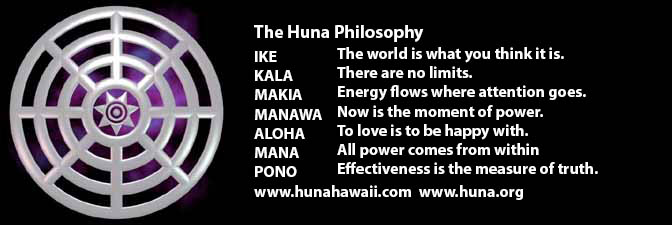
The first principle of Huna is Ike, the world is what you think it is. This also
says that we create our own reality but, with the other six principles, it acknowledges that everyone else
is creating their own realities alongside that and that these concurrent creations, we often say we live in
a consensus reality, are occurring at the same time and influence our creation process along the way.
It’s more useful to say we are creating our experience of this consensus reality. It’s also useful to
understand that others are doing the same thing and to be able to compartmentalise our focus and awareness
to a large degree. The reality someone else is creating may be very different from the one we desire. Part
of the first principle is the understanding that the world is also NOT what we currently think it is. This
allows for us to adopt new thinking and create better experience.
Being able to bring our focus back to what we personally are experiencing in our lives and making conscious
choices about that reduces the influence that the creation of others has on us. The more we can do this,
with the intent of making the world a better place, the more we influence the creation of others around us
in a beneficial way. This is a natural process, we’re not doing anything with the intent of changing the
behaviour of anyone else, we are simply working to improve our lives.
At the same time as focusing on what we personally are experiencing, we can be aware of what realities that
others are creating and, as a Kupua (shaman), I do that actively so that I may apply the skills I have
developed in a way that, hopefully, has a healing effect; in a way that opens the way for people around me
to see more effective choices in their own creations. Once they see new opportunities, it is still up to
them to choose.
I’m reminded of an exercise I learned in my shaman training and still do, when I remember, to this day. We
were hiking along the Bird Walk at Volcano on Hawaii’s Big Island. The exercise was to grok different role
models to see how it influenced our experience of the walk. I initially focussed on James Bond – 007 – and
paid attention to what I was noticing along the way and how I felt. After a time I noticed I was feeling a
little fatigued so I switched my attention to Sir Edmund Hilary, the first man to summit Mt Everest, and
noticed my stamina and endurance instantly increase.
I’ve just treated myself to a new camera for an upcoming visit to Hawaii. It is a full frame camera and it
uses different lenses from the APS-C camera I have upgraded from. I can no longer use the superzoom lens
that is so convenient for travel photography and have to decide which lens I can take with me. Over the
years I have noticed that I look at the world differently and look at different things when I have the
camera in my hand and which lens happens to be on the camera.
When I have the telephoto lens on I tend to look away into the distance and notice different things, not so
much detail but more of an encompassing view. When the wide angle is on I am looking close by, looking at
detail and possible patterns, shapes and lighting that might make an appealing image. Before I go out with
my camera I think about what kinds of images I want to capture and decide what lenses are best for that.
It's hard to get macro images with a wide angle lens for example. Sometimes I will just take it out with
whatever lens is on it and see where that leads my attention. The same approach is useful in life. Thinking
about what results we desire, we can begin to identify ideas and behaviours are likely to work best for
that. Sometimes we can temporarily adopt a different set of ideas and see how that changes our experience.
In different situations, it can be useful to modify ideas and behaviours temporarily, like when a teacher
goes to nightschool to learn new skills. It is usually more successful if he can shift his mind set from
that of a teacher to that of a student.
By noticing where our focus is, and what aspects of the world we tend to notice most, we can learn the skill
of shifting focus, looking at things in different ways and possibly changing our thinking so we can create
better and better experience day-by-day. Which lens are you using? Is it an appropriate lens for what you
wish to achieve? By becoming more conscious of our day-to-day decisions, we can change lenses or create new
ones to suit our desires.
Creating a better life for ourselves simply involves altering the internal rules that we live by, our
beliefs about ourselves and the world. We create different lenses by creating frameworks of thinking and
practicing using them. In this way we become more flexible and can move in and out of different states of
living as needed when we move through various situations and experiences. Change is inevitable and being
able to shift perspective and take a positive attitude to it is essential for a happy and productive life.
Graeme Kapono Urlich (December 2023)
Aloha New Zealand - School of Huna and Hawaiian Shamanism
|

